Porter's Five Forces of Unilever Group And Ariba Towards Strategic Sourcing Case Study Analysis
This is not the actual case solution. To get the case solution place your order on the site and contact website support.
Home >> Jamie Anderson >> Unilever Group And Ariba Towards Strategic Sourcing >> Porters Analysis
Porter's 5 Forces of Unilever Group And Ariba Towards Strategic Sourcing Case Solution
The porter five forces model would assist in getting insights into the Porter's 5 Forces of Unilever Group And Ariba Towards Strategic Sourcing Case Analysis market and determine the likelihood of the success of the options, which has actually been thought about by the management of the company for the function of handling the emerging problems associated with the reducing membership rate of customers.
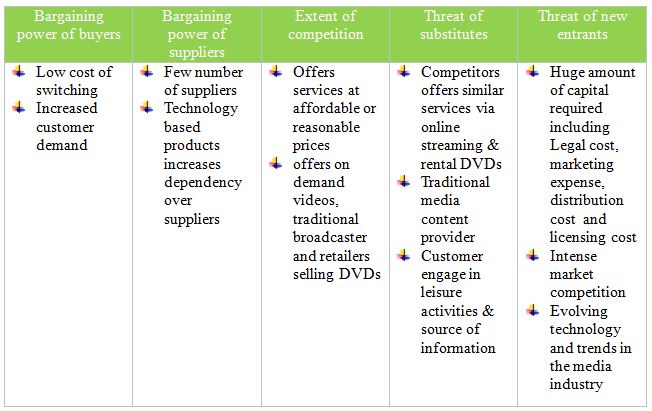
1. Intensity of rivalry
 It is to inform that the Porter's 5 Forces of Unilever Group And Ariba Towards Strategic Sourcing Case Analysis belongs of the international show business in the United States. The business has been engaged in supplying the services in more than ninety countries with the video on demand, items of streaming media and media provider.
The industry where the Porter's Five Forces of Unilever Group And Ariba Towards Strategic Sourcing Case Solution has been operating considering that its creation has lots of market gamers with the substantial market share and increased incomes. There is an extreme level of competitors or rivalry in the media and home entertainment market, compelling organizations to make every effort in order to maintain the existing consumers via using services at budget friendly or reasonable rates.
Quickly, the strength of rivalry is strong in the market and it is very important for the company to come up with distinct and innovative offerings as the audience or customers are more advanced in such modern-day innovation period.
2. Threats of new entrants
There is a high expense of entryway in the media and entrainment industry. The show business requires a big capital amount as the business which are taken part in supplying entertainment service have bigger start-up expense, that includes:
Legal cost.
Marketing expense.
Distribution cost.
Licensing cost.
In contrast, the existing entertainment provider has been thoroughly working on their targeted segments with the particular specialization, which is why the threat of brand-new entrants is low.
Another essential aspect is the strength of competitors within the essential market gamers in the market, due to which the brand-new entrant hesitate while participating in the market. Also, the technology and patterns in the media market are progressing on constant basis, which is adjusted by market competitors and Porter's 5 Forces of Unilever Group And Ariba Towards Strategic Sourcing Case Help. Despite the fact that, the brand-new entrant can quickly reproduce business model but what supplies edge to market competitors and Porter's Five Forces of Unilever Group And Ariba Towards Strategic Sourcing Case Analysis is benefit and series of available material. Acquiring such competitive advantage would need supplier agreements, capital expense and networking which would not be easy for the new entrants to follow.
3. Threat of substitutes
The risk of substitutes in the market posture moderate threat level in media and the show business. The company is facinga strong competition from the competitors providing comparable services through online streaming and rental DVDs. The traditional media content company is one of the example of the substitute products. The consumer may likewise take part in other pastime and source of details as compared to viewing media material and online streaming.
4. Bargaining power of buyer
The dynamics of media and home entertainment industry enables the customers to have high bargaining power. The low expense of changing makes it possible for the consumers to seek other media service companies and cancel their Porter's Five Forces of Unilever Group And Ariba Towards Strategic Sourcing Case Solution membership, thus increasing the organisation hazard.
5. Bargaining power of suppliers
Considering that Porter's Five Forces of Unilever Group And Ariba Towards Strategic Sourcing Case Help has actually been completing against the conventional supplier of home entertainment and media, it needs to show greater versatility in agreement as compared to the standard companies. The items is innovation based, the reliance of the business are increasing on continuous basis.
Objectives and Goals of the Business:
In Illinois, United States of America, among the greatest manufacturer of sensing unit and competitive company is Case Solution. The company is associated with manufacturing of broad item range and advancement of activities, networks and processes for being successful among the competitive environment of industry giving it a considerable benefit over competitiveness. The organization's objectives is mainly to be the producer of sensor with high quality and extremely personalized company surrounded by the premium market of sensor manufacturing in the United States of America.
The goal of the organization is to bring reduction in the product rates by increasing the sales system for every single product. The organizational management is included in decision of potential products to offer their consumer in both long term and short term implies. The organizational strength includes the establishment of competitive position within the manufacturing market of sensing unit in the United States of America on the basis of 5 pillars which includes customer care, efficiency in operation management, acknowledgment of brand, personalized capabilities and technical development.
The organization is a leading one and carrying out as a leader in the sensing unit market of the United States for their personalized services and systems of sensing unit. The company has used cross-functional managers who are responsible for change and understanding of the company's technique for competitiveness whereas, the company's weakness includes the choice making in regard to the items' removal or retention just on the basis of monetary aspects.