Porter's Five Forces of Role Of Capital Market Intermediaries In The Dot-Com Crash Of 2000 Case Study Help
This is not the actual case solution. To get the case solution place your order on the site and contact website support.
Home >> Krishna G Palepu >> Role Of Capital Market Intermediaries In The Dot-Com Crash Of 2000 >> Porters Analysis
Porter's Five Forces of Role Of Capital Market Intermediaries In The Dot-Com Crash Of 2000 Case Solution
The porter five forces design would assist in acquiring insights into the Porter's 5 Forces of Role Of Capital Market Intermediaries In The Dot-Com Crash Of 2000 Case Help industry and measure the probability of the success of the alternatives, which has actually been considered by the management of the business for the function of handling the emerging problems related to the minimizing subscription rate of consumers.
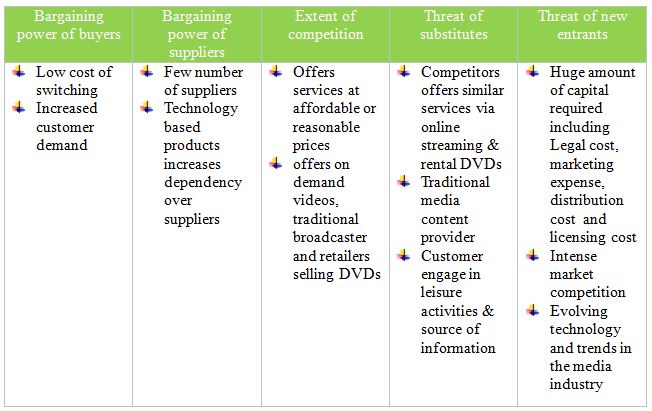
1. Intensity of rivalry
 It is to inform that the Porter's Five Forces of Role Of Capital Market Intermediaries In The Dot-Com Crash Of 2000 Case Solution belongs of the international entertainment industry in the United States. The company has been taken part in providing the services in more than ninety nations with the video on demand, products of streaming media and media provider.
The market where the Porter's Five Forces of Role Of Capital Market Intermediaries In The Dot-Com Crash Of 2000 Case Solution has actually been operating considering that its inception has lots of market gamers with the significant market share and increased earnings. There is an intense level of competition or rivalry in the media and home entertainment market, compelling companies to make every effort in order to maintain the current clients by means of offering services at budget-friendly or sensible rates.
Soon, the strength of rivalry is strong in the market and it is very important for the business to come up with unique and innovative offerings as the audience or clients are more advanced in such modern-day technology era.
2. Threats of new entrants
There is a high expense of entrance in the media and entrainment market. The entertainment industry requires a large capital quantity as the companies which are engaged in supplying entertainment service have larger start-up expense, which includes:
Legal cost.
Marketing expense.
Distribution cost.
Licensing cost.
On the other hand, the existing home entertainment service provider has actually been thoroughly working on their targeted segments with the particular specialization, which is why the danger of new entrants is low.
Another essential aspect is the intensity of competitors within the key market gamers in the market, due to which the brand-new entrant hesitate while participating in the market. The technology and patterns in the media industry are developing on consistent basis, which is adapted by market rivals and Porter's Five Forces of Role Of Capital Market Intermediaries In The Dot-Com Crash Of 2000 Case Analysis. Although, the new entrant can quickly reproduce business design however what provides edge to market competitors and Porter's Five Forces of Role Of Capital Market Intermediaries In The Dot-Com Crash Of 2000 Case Help is convenience and range of available material. Gaining such competitive benefit would require supplier contracts, capital investment and networking which would not be easy for the new entrants to follow.
3. Threat of substitutes
The danger of alternatives in the market posture moderate risk level in media and the entertainment market. The customer might likewise engage in other leisure activities and source of information as compared to enjoying media material and online streaming.
4. Bargaining power of buyer
The characteristics of media and show business allows the customers to have high bargaining power. The earnings and sales created by business are based on the customers placed in diverse areas all around the world. The low cost of switching makes it possible for the consumers to look for other media service companies and cancel their Porter's 5 Forces of Role Of Capital Market Intermediaries In The Dot-Com Crash Of 2000 Case Solution subscription, thus increasing the company risk. Due to this, the business might not charge high prices for services from the customers, and it must keep the rates strategy according to customer need, with very little increase in rate.
5. Bargaining power of suppliers
Since Porter's 5 Forces of Role Of Capital Market Intermediaries In The Dot-Com Crash Of 2000 Case Help has been completing versus the conventional distributor of entertainment and media, it requires to show higher versatility in contract as compared to the traditional companies. The products is innovation based, the dependence of the business are increasing on continuous basis.
Goals and Objectives of the Business:
In Illinois, United States of America, among the greatest manufacturer of sensing unit and competitive organization is Case Solution. The company is associated with manufacturing of broad item variety and advancement of activities, networks and processes for achieving success amongst the competitive environment of industry offering it a significant advantage over competitiveness. The company's objectives is mainly to be the maker of sensor with high quality and extremely customized organization surrounded by the premium market of sensor production in the United States of America.
The aim of the company is to bring decrease in the product prices by increasing the sales unit for each item. Second of all, the organizational management is involved in decision of possible products to offer their client in both long term and short-term suggests. The organizational strength includes the facility of competitive position within the production market of sensing unit in the United States of America on the basis of five pillars that includes customer care, efficiency in operation management, acknowledgment of brand name, adjustable abilities and technical development.
The organization is a leading one and performing as a leader in the sensing unit market of the United States for their adjustable services and systems of sensor. Development in ideas and product creating and arrangement of services to their customers are among the competitive strengths of the company. The organization has actually employed cross-functional supervisors who are accountable for adjustment and understanding of the organization's technique for competitiveness whereas, the company's weakness includes the choice making in regard to the products' deletion or retention only on the basis of financial elements. The measurement of ROIC is not associated with the trade incorporation and concerns of customers.